James
The book of James challenges us with the most basic and essential realities of life, driving us to face up to the truth about following Jesus the Messiah. James gives us the truth without ornament. He cuts through the kinds of excuses and delusions we cloud ourselves with. It often seems that people speak of “faith” as if it were a matter of vague and dreamy ideas. People sometimes imagine that a mere intellectual assent to propositions within the Creed was the same as genuine faith in Jesus. Others think that ‘believing in Jesus’ is just about eternal fire insurance rather than actually following the LORD Jesus day-by-day. As we study James we will find all such empty notions of ‘faith’ destroyed.
Unlike many New Testament letters, we know very little about the background of this letter. It isn’t addressed to a particular church in a city like Paul’s letters to the Galatians, Romans, Corinthians etc. We don’t know the date of the letter because there are no historical references.
It is not absolutely certain which James actually wrote this letter, because he says so little about himself. He begins by describing himself as “a servant of God and the Lord Jesus Christ”, without giving us any specific job description for himself.
However, the James that we meet in the book of Acts and in the letters of Paul seems to fit the bill exactly. We see him in the book of Acts wrestling with the influx of Gentiles into the people of Israel. In the words of Romans 11, the wild branches were being grafted onto the olive tree of Israel. For more than 1500 years Gentiles had to become Jews in order to join Israel… but now, with the fulfillment of the Law in Jesus’ death, the Gentiles could remain as Gentiles and be welcomed into Israel.
Some have said that James was opposed to this, even if only temporarily, shown by the fact that Peter compromised on the gospel when men were sent from James [Galatians 2:11-14]. This might be so, but in Acts 15:13-21 we see James leading the council of Jerusalem in acknowledging the Old Testament teaching about the time when Gentiles would be part of Israel. In Acts 21:17-26 we see James dealing with the anti-Paul feeling among some of the Jewish believers who had not yet understood the Scriptures as he had done. In Galatians 2:9 Paul recalls how James welcomed the Gentile mission work.
In Acts 12:17; 15:13 and 21:18 we see James’ leading role in the Jerusalem church. James had enjoyed a personal appearance from Jesus after His resurrection [1 Corinthians 15:7]. Most fascinating of all we see in Galatians 1:19 that Paul refers to James as the brother of the Lord. Furthermore, Jude 1 tells us that Jude was the brother of James, indicating that Jude was also a brother of Jesus. We see this explicitly confirmed in Matthew 13:55. If James and Jude had grown up in the same household as Jesus and enjoyed His company and Bible study for so many years, we would expect them to be leaders in that early expansion of Israel. What an amazing childhood they must have enjoyed together!
Theodoretus in the 4th century AD quotes from a first century Christian concerning James. There is no guarantee that all of these comments are true of James, but they provide a fascinating [if unusual] portrait of the great man.
Hegesippus who lived near the apostolic age, in the fifth book of his Commentaries, writing of James. says
"After the apostles, James the brother of the Lord surnamed the Just was made head of the Church at Jerusalem... This one was holy from his mother's womb. He drank neither wine nor strong drink, ate no flesh, never shaved or anointed himself with ointment or bathed. He alone held the privilege of entering the Holy of Holies, since indeed he did not use woolen vestments but linen and went alone into the temple and prayed in behalf of the people, insomuch that his knees were reputed to have acquired the hardness of camels' knees."
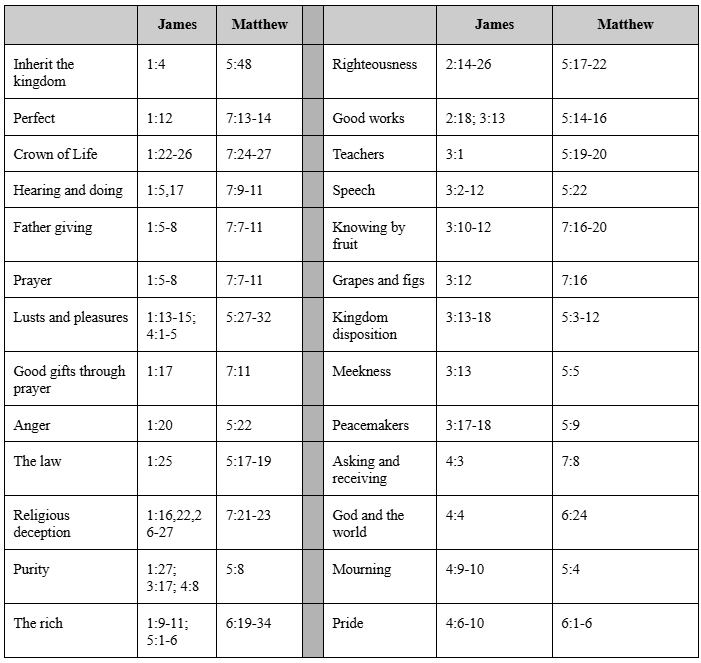
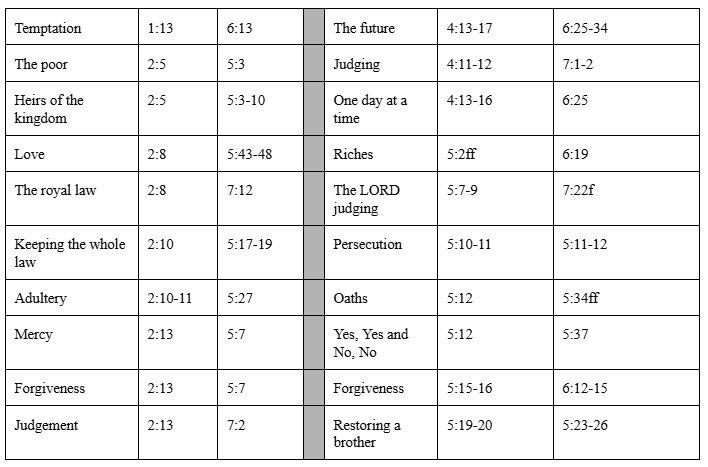
Sometimes people have wondered just how ‘Christian’ the book of James is because Jesus is only mentioned explicitly in 1:1 and 2:1. However, as we understand the book in a more thorough way we see that Jesus is present at every point. He is the source of all that James teaches. The connection between the teaching of James and the teaching of Jesus is so strong that the letter only makes sense when we have the teaching of Jesus alongside the text of James’ letter.
“In the epistle of James the Holy Spirit has given the church a commentary on Jesus’ Sermon on the Mount and Sermon on the Plain, a commentary that is rich in applications for daily life.”
George Stulac, James, [IVP, Leicester, 1993], note on page 34
J. A. Robertson: the words of Jesus “drop out freely and spontaneously, as from a mind that had so absorbed them that they had become part and parcel of its very self.”
R. R. Williams: “much of James reads like the gospel of Jesus rather than the gospel about Jesus.”
For this reason we have chosen to set the relevant teaching of Jesus at the beginning of each section of teaching so that we can see for ourselves how Jesus’ brother was so saturated with His teaching. The website thechristian.org contains a list showing the close parallels between the book of James and Jesus’ sermon on the mount.